Climate
Climate refers to the average, year-after-year conditions of temperature, precipitation, winds, and clouds in an area. Scientists use two main facrors - precipitation and temperature - to describe the climate of a region. A climate region is a large area that has similar climate conditions throughout. For example, the climate in the southwestern United States is dry, with hot summers.
The factors that affect large climate regions also affect smaller areas. Have you ever noticed that it is cooler and more humid in a grove of trees than in an open field? A small area with climate conditions that differ from those around it may have its own microclimate.
Factors Affecting Temperature
The main factors that influence temperature are latitude, altitude, distance from large bodies of water, and ocean currents.
Latitude
In general, climates of locations near the equator are warmer than climates of areas far from the equator. The reason is that the sun's rays hit Earth's surface most directly at the equator. At the poles, the same amount of solar radiation is spread over a larger area, and therefore brings less warmth.
The tropical zone is the area near the equator, between about 23.5 degrees north latitude and 23.5 degrees south latitude. The tropical zone receives direct or nearly direct sunlight all year around, making climates there warm.
In contrast, the sun's rays always strike at a lower angle near the North and South poles. As a result, the areas near both poles have cold climates. These polar zones extend from about 66.5 degrees to 90 degrees north and 66.5 degrees to 90 degrees south latitudes.
Between the tropical zones and the polar zones are the temperate zones. In summer, the sun's rays strike the temperature zones more directly. In winter, the sun's rays strike at a lower angle. As a result, the weather in the temperate zones ranges from warm or hot in summer to cool or cold in winter.
Altitude
In the case of high mountains, altitude is a more important climate factor than latitude. In the troposphere, temperature decreases about 6.5 Celsius degrees for every 1 km increase in altitude. As a result, highland areas everywhere have cool climates, no matter what their latitude.
Distance from Large Bodies of Water
Oceans or large lakes can affect temperatures. Water heats up more slowly than land. It also cools down more slowly. Therefore, winds off the ocean often prevent extremes of hot and cold in coastal regions. Much of the west coasts of North America, South America, and Europe have mild marine climates, with relatively mild winters and cool summers.The centers of North America and Asia are too far inland to be warmed or cooled by the ocean. Most of Canada and of Russia, as well as the central United States, have continental climates. Continental climates have more extreme temperatures than marine climates. Winters are cold, while summers are warm or hot.
Ocean Currents
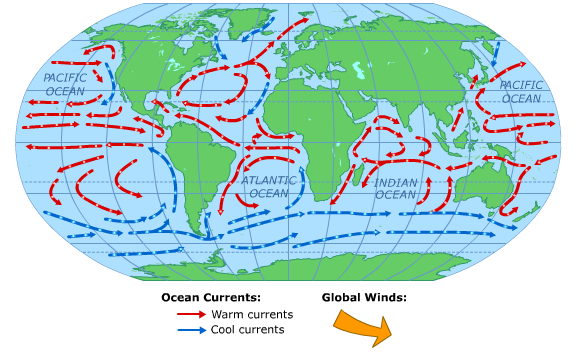
Marine climates are influenced by ocean currents, streams of water within the oceans that move in regular patterns. Some warm ocean currents move from the tropics towards the poles. This affects climate as the warm ocean water warms the air above it. The warmed air then moves over nearby land. In the same way, cold currents bring cold water from the polar zones toward the equator. A cold current brings cool air. Below is a diagram of the major surface ocean currents.